
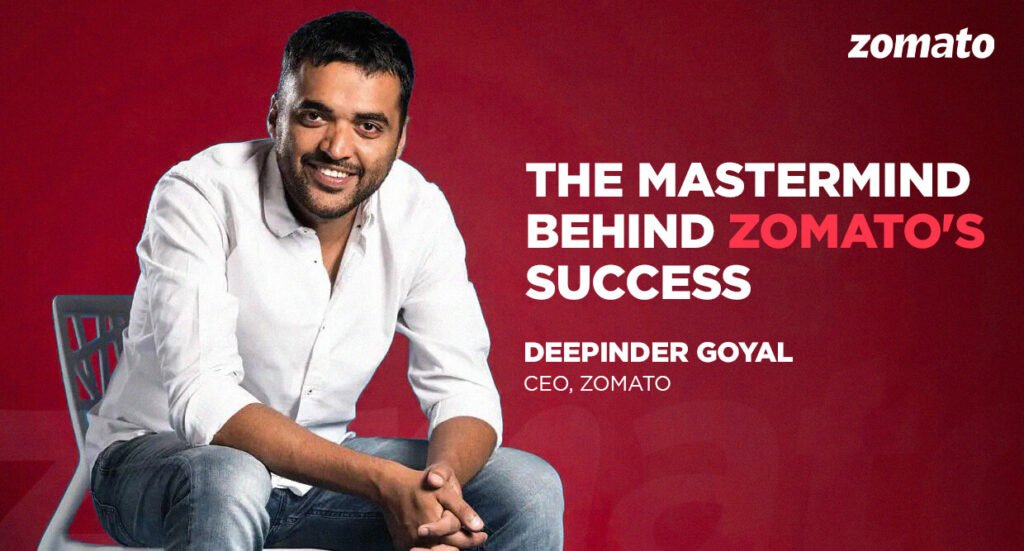
The Hook: What started in 2008 as a simple project to scan office cafeteria menu cards has today evolved into India’s dominant food delivery and quick-commerce powerhouse. This is the ultimate playbook of Zomato a journey built on bold risks, calculated pivots, and relentless execution.
Phase 1: The Humble Beginning & The Spark (2008–2011)
- The Inception: In 2008, IIT Delhi alumni Deepinder Goyal and Pankaj Chaddah noticed that corporate employees spent valuable lunch hours waiting in long lines or sorting through physical paper menu cards to order food.
- Foodiebay to Zomato: They started scanning these menus and uploading them onto an internal intranet site for colleagues. Seeing massive internal traction, they launched it publicly as Foodiebay. In 2010, they rebranded the platform to Zomato to prevent trademark clashes with eBay and expand beyond just food.
- The Core Value Proposition: Initially, Zomato was strictly a restaurant discovery and review platform. It helped users find places to eat, check menus, and read ratings, solving a major information asymmetry problem in the urban dining market.
Phase 2: International Expansion & The Delivery Wars (2012–2017)
- Scaling Borders: Zomato expanded rapidly outside India, launching operations in international markets like the UAE, UK, South Africa, Australia, and the Philippines, positioning itself as a global restaurant directory.
- The Entry of Competition: Around 2015, Swiggy entered the market with a hyper-focused approach on logistics and food delivery. Zomato quickly realized that discovery alone wouldn’t secure their future; they had to build a massive delivery infrastructure.
- The Burn Rate Challenge: Entering the food delivery space meant competing in a high-burn, capital-intensive war. Both players offered heavy discounts, leading to massive financial losses and cash burn. However, Zomato raised substantial venture capital funding to stay in the race.
Phase 3: The Pandemic Crisis, Diversification, and IPO (2018–2021)

- The COVID-19 Shock: When the global pandemic struck in 2020, dine-in revenues dropped to absolute zero overnight. Zomato faced a severe existential crisis, forcing them to lay off a significant portion of their workforce and cut costs aggressively.
- Pivoting to Survival: To survive, Zomato rapidly innovated by launching grocery delivery (temporarily) and pivoting heavily toward contactless delivery and safety protocols.
- The Historic IPO: In July 2021, Zomato made history by launching its Initial Public Offering (IPO) on Indian stock exchanges. It became India’s first major tech unicorn to go public, paving the way for the broader Indian startup ecosystem.
Phase 4: The Blinkit Bet and the Quick-Commerce Revolution (2022–Present)
- The Controversial Acquisition: In 2022, Zomato made its boldest and most criticized move—acquiring the struggling quick-commerce grocery startup Blinkit for ₹4,447 crore. Wall Street analysts and public investors initially punished Zomato’s stock, questioning why a food delivery giant would buy a heavy-loss-making instant grocery delivery company.
- The Masterstroke Execution: Deepinder Goyal believed that consumer habits were permanently shifting toward instant gratification. Zomato integrated its massive delivery network with Blinkit’s dark stores.
- The Present Reality: Today, Blinkit has completely turned around, growing at a blistering pace that frequently outperforms Zomato’s core food delivery business, cementing Zomato Ltd. as a multi-billion-dollar tech conglomerate.
Key Business & Entrepreneurial Takeaways from Zomato
1. Embrace Continual Pivots: Zomato started as a menu scanner, transitioned into a review directory, evolved into a logistics network, and has now transformed into a quick-commerce titan. Adaptation is survival.
2. High-Conviction Risk Taking: Buying Blinkit when critics called it a failure proved that founders must sometimes ignore conventional market noise and trust their long-term vision.
3. Mastering Brand Identity: Zomato mastered cultural relevance through witty push notifications and relatable social media marketing, keeping customer acquisition costs low through organic virality.